Published on 9 October 2026
From AI Pilots to Measurable Business Workflows
Learn how to move AI pilots into governed business workflows measured by cost, accuracy, turnaround time and completed outcomes.
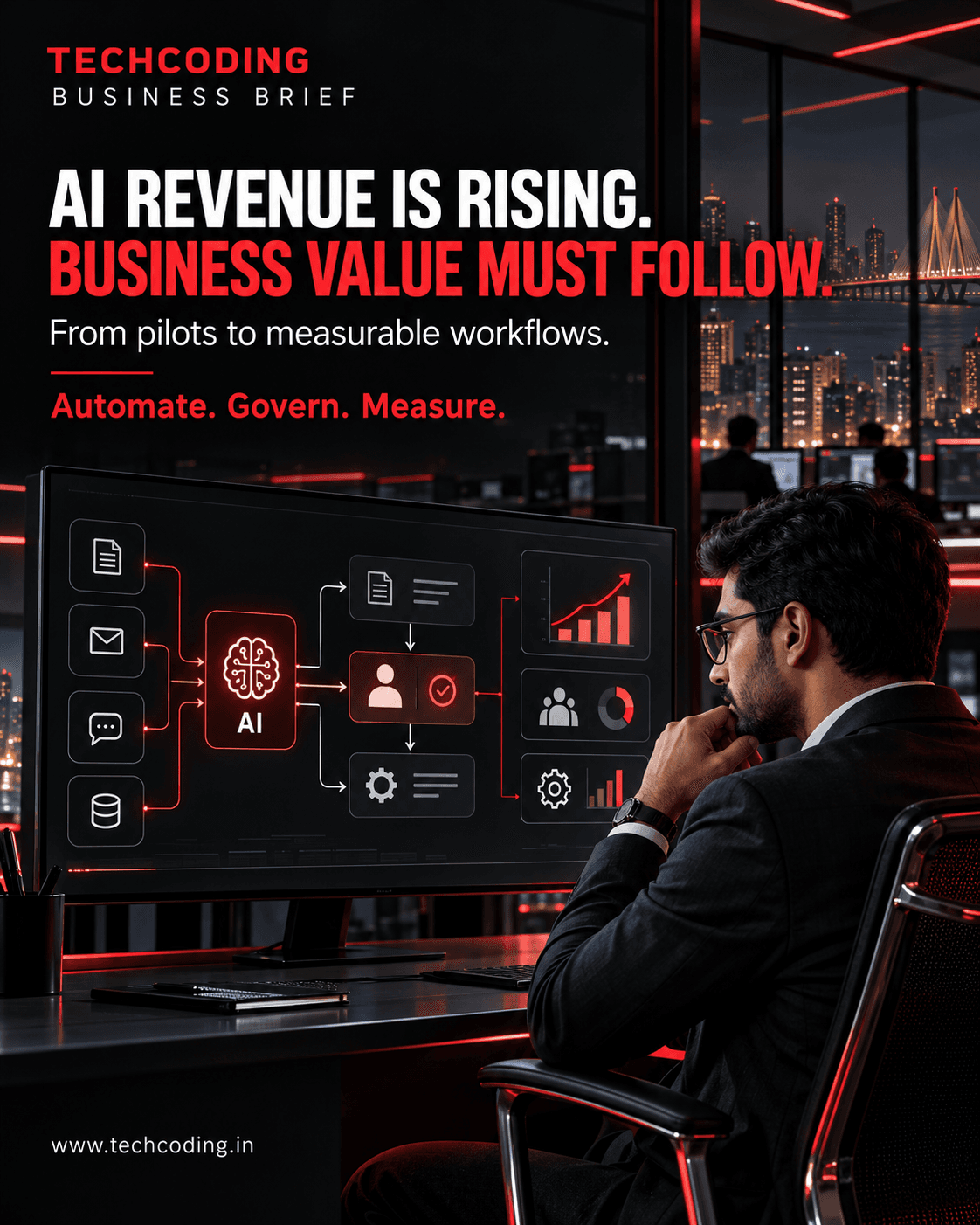
Businesses have spent several years experimenting with AI assistants, content generation, document analysis and automation.
The next phase is more demanding: proving that these systems deliver dependable business value.
TCS reported annualised AI revenue of $3.1 billion for the quarter ending September 30, 2026. That represented more than 10% of revenue and increased from $2.6 billion in the preceding quarter.
At the same time, total sequential revenue growth was 0.5% in constant currency. tcs.com
These results do not determine how every company should invest. They do illustrate the growing commercial scale of enterprise AI—and the need to connect that spending with measurable outcomes.
Why many AI pilots fail to become production systems
A pilot usually operates within a controlled environment. It uses a small dataset, supports a limited group of users and may not connect with live operational systems.
Production introduces harder requirements:
Real customer and operational data
Identity and access management
Integration with existing software
Predictable response times
Exception handling
Monitoring and audit logs
Human approval
Cost controls
Defined accountability
A model can perform well in a presentation while the surrounding workflow remains unreliable.
This is why businesses should design the complete operating process—not only the AI prompt.
Start with a specific outcome
“Implement AI” is not a measurable objective.
A better objective defines the task, owner and expected result. Examples include:
Reduce first-response time for support enquiries.
Extract application data without increasing error rates.
Prioritise sales leads using approved CRM information.
Reconcile payment records with fewer manual exceptions.
Summarise customer cases before an employee responds.
Detect missing loan documents before underwriting begins.
Each objective can be measured against an existing baseline.
Starting with the outcome also prevents businesses from selecting a model before understanding what the workflow needs.
Measure completed workflows—not isolated model usage
Token consumption and API pricing affect cost, but neither reveals whether a business process succeeded.
Oracle India’s Vivek Gupta recommends measuring the economics of AI per completed workflow. This broader calculation can include model usage, data retrieval, system integration, monitoring and human review. Express Computer
A support automation workflow, for example, could track:
Total monthly operating cost
Number of enquiries processed
Number resolved successfully
Escalations requiring employees
Incorrect or incomplete responses
Average resolution time
Customer satisfaction
Dividing total cost by successfully completed, governed outcomes creates a more realistic measure than cost per token.
Keep human approval where consequences matter
AI can classify, summarise, extract and recommend. It should not automatically receive unlimited authority.
A lending workflow might use AI to extract information from documents and highlight inconsistencies. An approved rule engine can then apply defined policies, while an authorised employee reviews exceptions and makes consequential decisions.
Human approval is particularly important when a workflow can:
Change a financial record
Approve or reject an application
Issue a refund
Modify contractual information
Send sensitive customer communication
Publish a public claim
Trigger a payment
The system should record which user or automated component performed each action.
Give AI the minimum necessary access
An AI agent connected to operational systems can create more value than a standalone chatbot. It can also create more risk.
Every agent should have its own defined identity and only the permissions required for its assigned task.
Practical controls include:
Role-based permissions
Restricted API endpoints
Read-only access where possible
Short-lived credentials
Approved data sources
Transaction limits
Maker-checker approval
Complete action logs
Immediate access revocation
An agent that drafts a CRM note does not automatically need permission to delete customer records or change account terms.
Plan for exceptions and failures
Production workflows encounter incomplete data, unavailable APIs, duplicated requests and unexpected model responses.
A reliable implementation needs:
Input validation
Timeouts and controlled retries
Duplicate-action protection
Fallback responses
Manual-review queues
Versioned prompts and rules
Error categorisation
Incident alerts
Rollback procedures
A failed AI request should never leave a customer application, payment or CRM case in an unknown state.
Create a business-value dashboard
Management needs visibility into results without reviewing technical logs.
A practical dashboard can combine:
Workflow volume
Successful completion rate
Average turnaround time
Exception and escalation rates
Human-review time
Cost per completed workflow
Customer feedback
Revenue or savings attribution
Security interventions
Performance by model or workflow version
These measurements allow the business to expand workflows that perform well and redesign those that do not.
How TechCoding can help
TechCoding develops AI-enabled business systems around existing operations rather than treating AI as an isolated feature.
Services can include:
AI workflow discovery and design
CRM automation
NBFC LOS and LMS integrations
Document extraction and validation
Customer-support automation
Approval and escalation workflows
Secure API development
Role-based access controls
Activity and audit logging
Performance and cost dashboards
Human-in-the-loop interfaces
The objective is not to launch the largest number of AI pilots. It is to build controlled workflows that complete useful work and produce results the business can verify.
Visit www.techcoding.in to discuss an AI and business-automation workflow.